
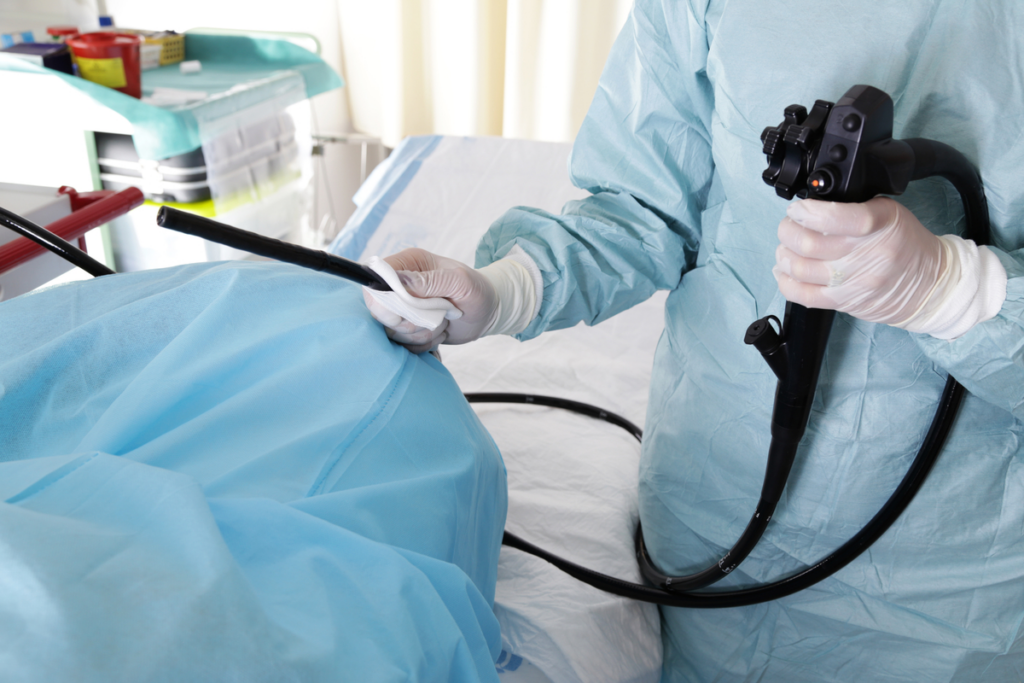
Let’s be honest, nobody dreams about getting a colonoscopy.
The prep, the fasting, the day lost to sedation recovery. It’s one of those things people quietly add to their mental “I’ll deal with it later” list. Then later becomes next year. Next year will be five years. And five years is a long time when it comes to colorectal cancer, the second leading cause of cancer-related deaths in the United States.
So when a test came along promising to screen for colon cancer from the comfort of your own bathroom, no prep, no needles, no hospital gown, people paid attention.
That test is Cologuard. Whether you’ve seen the commercials, had your doctor bring it up, or are simply trying to understand your options, you’re in the right place. By the end of this, you’ll know exactly what Cologuard is, how it works, who it’s for, and what to do next.
What Is Cologuard?
Cologuard is an FDA-approved, at-home colorectal cancer screening test. You collect a stool sample, ship it to a lab with a prepaid label, and get results without ever setting foot in a clinic.
It’s made by Exact Sciences, a precision oncology company based in Madison, Wisconsin, and became the first stool DNA test approved by the FDA in August 2014. Since then, millions of Americans have used it as a legitimate, medically credible alternative to the traditional colonoscopy.
What most people don’t realize going in: Cologuard still requires a doctor’s prescription. It’s a real medical test, just one that happens entirely at home.
What makes it different from older at-home tests like FIT (fecal immunochemical test) or FOBT (fecal occult blood test) is the technology. Those tests only detected blood in the stool. Cologuard goes further, it analyzes both blood and abnormal DNA shed by cancerous or precancerous cells. That’s a meaningful leap forward in what a home test can actually catch.
Why Colorectal Cancer Screening Matters More Than You Think
Colorectal cancer almost always starts as a polyp, a small, benign growth on the inner lining of the colon. Most polyps are harmless. But some, over years or even decades, undergo genetic mutations and slowly transform into cancer.
The terrifying part? During most of that process, there are zero symptoms. No pain. No blood you can see. No warning. People feel completely fine while something dangerous grows quietly inside them.
This is why screening exists, not to find cancer after you feel sick, but to catch the problem at the polyp stage, before it ever becomes cancer at all.
The survival numbers say everything. Colorectal cancer caught at Stage 1 has a survival rate above 90%. By Stage 4, it drops to around 14%. Same disease. Wildly different outcomes. The only difference is when it gets found.
Yet one in three Americans between 45 and 75 aren’t up to date on colorectal screening. The barriers are real, fear, inconvenience, embarrassment, cost. And the colonoscopy, for all its effectiveness, does almost nothing to lower those barriers. That is exactly the gap Cologuard was designed to fill.
How Does Cologuard Actually Work?
The process is simpler than most people expect. From prescription to results, the whole thing typically takes two to three weeks.
- Your doctor prescribes it. A quick conversation at your appointment, and your doctor submits a prescription electronically to Exact Sciences. Done in minutes.
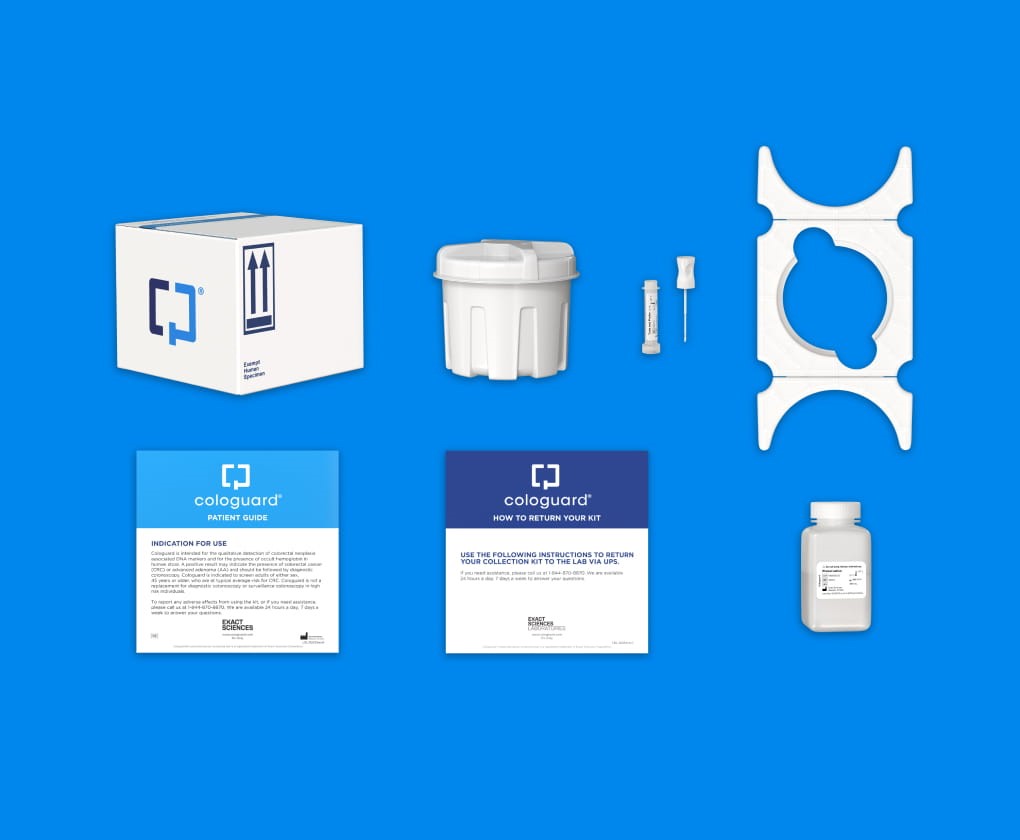
- The kit arrives at your door. Within a few days. Inside: a collection container, a toilet bracket, preservative solution, a sample tube, clear instructions, and a prepaid UPS label. Everything included.
- You collect the sample at home. In your own bathroom, on your own schedule. Most people find it far less unpleasant than expected. About 20–30 minutes start to finish.
- You ship it the same day. The sample must be mailed within 24 hours of collection to preserve DNA integrity. Drop it at any UPS location — the label is already in the box.
- The lab analyzes it. Scientists run a two-part test: checking for abnormal DNA biomarkers associated with cancer and precancerous polyps, and checking for traces of blood in the stool.
- Your doctor gets the results. Usually within one to two weeks. They contact you to go over what it means and what comes next.
A test operating at the molecular level, completed from your home, on your schedule, with zero lifestyle disruption.
The Science — What Is It Actually Looking For?
This is the part most people never fully understand, and it’s genuinely worth knowing.
As abnormal cells grow along the colon lining, they shed microscopic amounts of DNA into the passing stool. That DNA carries the same genetic mutations as the polyp or tumor it came from. Cologuard’s lab analysis is built to find those mutations.
Specifically, the test screens for:
- KRAS gene mutations — present in roughly 40% of colorectal cancers. A mutated KRAS gene acts like a stuck accelerator, telling cells to keep growing when they should stop.
- Abnormal methylation of NDRG4 and BMP3 genes — a chemical change that alters how genes are switched on and off, strongly linked to colorectal tumor development.
- Hemoglobin — blood protein whose presence in stool signals potential bleeding from a polyp or tumor in the lower GI tract.
All three markers feed into an algorithm that delivers one of two outcomes: positive or negative.
Think of it as reading the genetic fingerprints cancer leaves behind, long before any symptoms appear, and long before you’d ever know anything was wrong.
Who Is Cologuard Right For?
This is the most important section in this article. Cologuard is excellent for a specific group of people, and genuinely the wrong choice for others.
It is designed and validated for average-risk adults aged 45 to 75. You are likely a good candidate if you meet these criteria:
- No personal history of colorectal cancer or advanced polyps
- No first-degree relatives diagnosed with colorectal cancer — especially before age 60
- No inflammatory bowel disease (Crohn’s or ulcerative colitis)
- No hereditary syndrome like Lynch syndrome or familial adenomatous polyposis (FAP)
- Your doctor agrees it’s appropriate for your situation
Cologuard is not appropriate if you have a strong family history of colorectal cancer, have had cancer or advanced polyps yourself, have inflammatory bowel disease, or carry a hereditary high-risk condition.
The clinical trials validating Cologuard were run exclusively in average-risk populations. Using it in a high-risk situation isn’t just less effective, it can create dangerous false reassurance. When it comes to cancer, false reassurance is its own kind of risk.
If you’re unsure which category applies to you, that’s exactly the conversation to have with your doctor before ordering.
How Accurate Is It? The Real Numbers.
The landmark DeeP-C trial, published in the New England Journal of Medicine in 2014 enrolled nearly 10,000 average-risk adults. Every participant received both Cologuard and a colonoscopy, allowing a direct head-to-head comparison.
The results:
- Cologuard detected 92.3% of colorectal cancers — strong sensitivity for a non-invasive test
- It caught 42.4% of advanced precancerous polyps — significantly better than FIT’s 23.8%
- The FIT test, by comparison, detected 73.8% of cancers — solid, but noticeably lower
- False positive rate was 13.6% — roughly 1 in 7 people without cancer got a positive result and needed follow-up
Cologuard is excellent at detecting existing cancers. It’s decent, but not complete, at catching polyps before they become cancerous. And the false positive rate means some people will go through the stress of a positive result only to find nothing on their follow-up colonoscopy.
No screening test is perfect. The real question is whether catching cancer early outweighs the cost of the occasional false alarm. For the millions of Americans who would otherwise skip screening entirely, the answer is a clear yes.
Cologuard vs Colonoscopy — The Honest Comparison
This isn’t a rivalry. They’re different tools. But here’s the side-by-side you need:
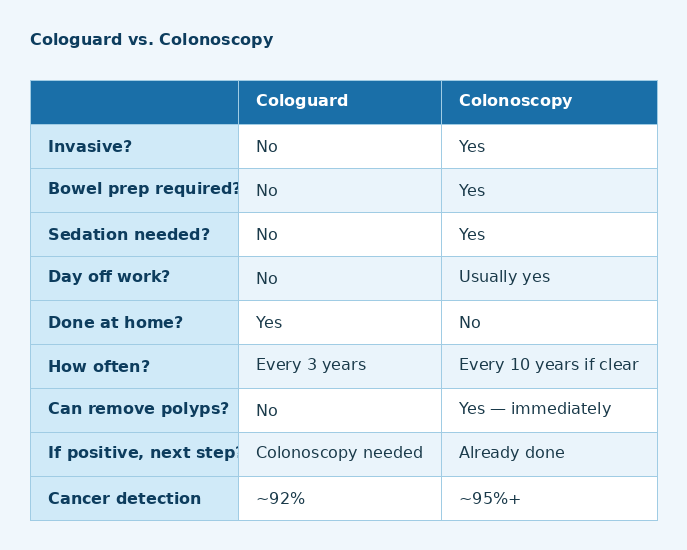
The key point: a positive Cologuard result still leads to a colonoscopy. A colonoscopy doesn’t just look, it acts. Polyps found during a colonoscopy are removed on the spot. Cologuard flags the problem; it can’t fix it.
That said, a Cologuard done today beats a colonoscopy scheduled for “sometime next year” every single time. The best screening test is the one you’ll actually do.
What Does It Cost?
With private insurance: Most plans cover Cologuard fully for eligible average-risk patients 45+. Under the ACA, recommended preventive screenings must be covered without cost-sharing. Confirm with your insurer before ordering, not every plan is identical.
With Medicare: Part B covers Cologuard every three years for average-risk beneficiaries aged 45–75. No deductible, no copay. Effectively free.
Without insurance: List price is approximately $600–$700. Exact Sciences offers a patient assistance program. Call 1-844-870-8870 before assuming you’re paying full price.
Important: If your result is positive and you need a follow-up colonoscopy, that procedure may be billed as diagnostic rather than preventive, which can change your out-of-pocket costs. Ask your insurer about this before you start.
What Happens After Your Results?
If your result is negative: You’re cleared for three years. No follow-up needed. If symptoms develop before your next test, rectal bleeding, unexplained changes in bowel habits, persistent abdominal pain, contact your doctor regardless.
If your result is positive: Take a breath. A positive result does not mean cancer.
It means something was detected that warrants a closer look, abnormal DNA, blood, or both. The next step is a diagnostic colonoscopy. Many people with positive Cologuard results have their colonoscopy come back completely clear.
Positive means “look further” — not “confirmed diagnosis.”
If you get a positive result:
- Call your doctor the same day, don’t let anxiety cause delays
- Schedule your follow-up colonoscopy within weeks, not months
- Ask your doctor exactly what was detected and what to expect
- Arrange your logistics in advance, you’ll need a driver and a day off work
Time matters. Don’t sit on it.
How to Get Cologuard
Step 1 — Talk to your doctor. At your next physical or by scheduling a dedicated appointment, ask whether Cologuard is right for you based on your age and risk profile. Most primary care doctors can prescribe it in minutes.
Step 2 — Consider telehealth. If access to a doctor has been the barrier, several telehealth platforms now offer Cologuard prescriptions through a virtual visit. No in-person appointment required.
Step 3 — Confirm insurance coverage first. One quick call to your insurer before the kit ships can save you from a surprise bill later.
Step 4 — When the kit arrives, use it. Don’t let it sit. Clear a morning, follow the instructions, ship it the same day. The hardest part is simply deciding to act.
Cologuard has removed every practical barrier that was standing between you and colorectal screening. No prep, no clinic, no sedation, no day off work. What’s left is just the decision.
Final Thoughts
Colorectal cancer is largely preventable, and Cologuard has made the path to early detection more accessible than ever before. For average-risk adults who have been putting off screening, this at-home test offers a medically validated, convenient, and non-invasive way to take action. At the same time, it’s important to use Cologuard within the right context, understanding its limitations, following up diligently on positive results, and working with a qualified gastroenterologist who can guide you toward the best screening strategy for your individual needs.
If you’re 45 or older and haven’t been screened for colon cancer, now is the time to change that. Schedule a colon cancer screening consultation with our GI clinic today and let our team help you protect your digestive health with the right plan for you.